Cryo-EM Processing Pipeline
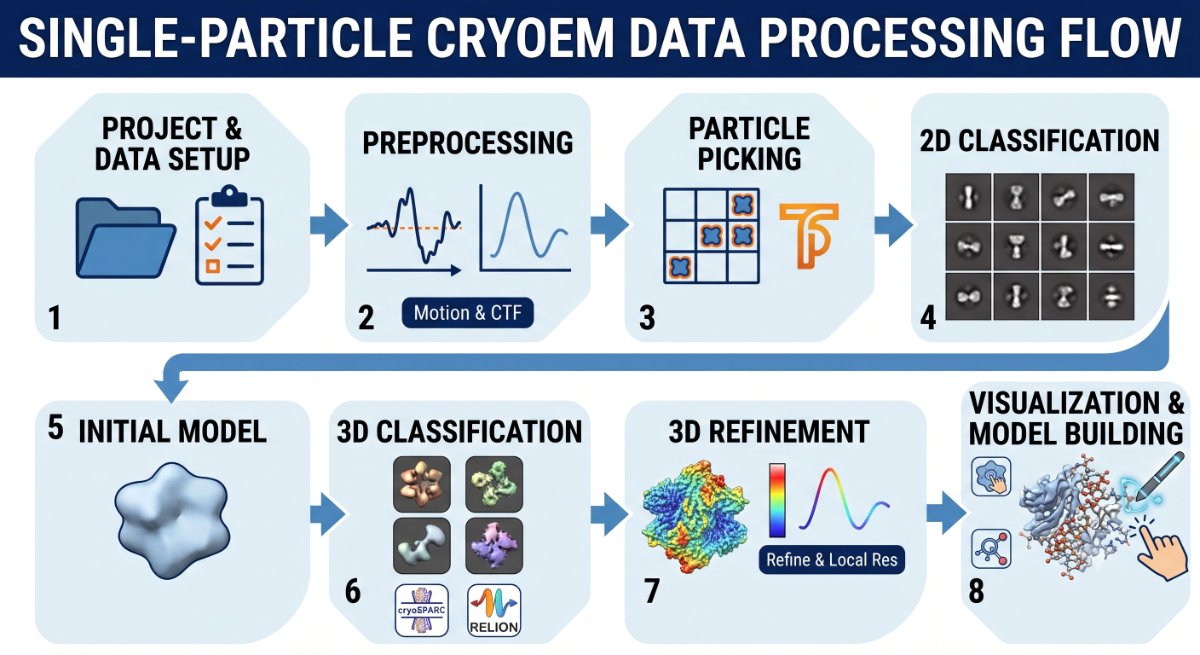
The end-to-end single-particle workflow our trainees follow, from raw movie frames to a refined, interpretable 3D reconstruction. Adapted from the SBGrid NIH R25 Train-the-Trainer curriculum, co-led by our lab.
Workflow steps
A complete image-processing pipeline carrying raw detector movies through to a filtered, interpretable density map — the same sequence taught in SBGrid's two-day Single-Particle CryoEM Data Processing curriculum.
Motion correction & CTF estimation
Correct beam-induced motion across movie frames and estimate the contrast transfer function per micrograph to recover high-resolution signal.
Initial model generation
Generate a low-resolution ab initio 3D model directly from the cleaned 2D particle stack, with no external structural prior required.
Local resolution estimation & filtering
Map local resolution across the reconstruction and apply resolution-aware filtering/sharpening so weaker, flexible regions aren't over-sharpened.
Visualization & interpretation
Inspect the final density map in ChimeraX to assess map quality and hand off to model building (see the companion Model Building & Validation Workflow).
Worked training example
EMPIAR‑11422 — full-length dimeric ClbP
The SBGrid Train-the-Trainer curriculum runs this exact pipeline on a real Titan Krios dataset, EMPIAR‑11422, which produced the cryo-EM structure of full-length dimeric ClbP (PDB 7UL6; EMD‑26593), originally published by Velilla and colleagues in 2022. Trainees work with authentic experimental data end-to-end rather than a synthetic tutorial dataset.
References
Primary sources for this workflow. Each link goes to the original resource so you can confirm details directly.